Colophon
Every element on my site is considered. The typeface, the colors, image format, section dividers, the domain. Nothing is default. Nothing is generated. This is handcrafted validated HTML and CSS and nothing else. No JavaScript. No framework. No content management system. No build tools. No spying.
Where something is worth paying for, I pay for it. That’s how good work survives. When everything is free, you are the product, and the internet becomes what it has largely become — a surveillance machine dressed up as convenience. I’m asking you to pay me for what I do, so it seems only right to show you that I do the same.
The name
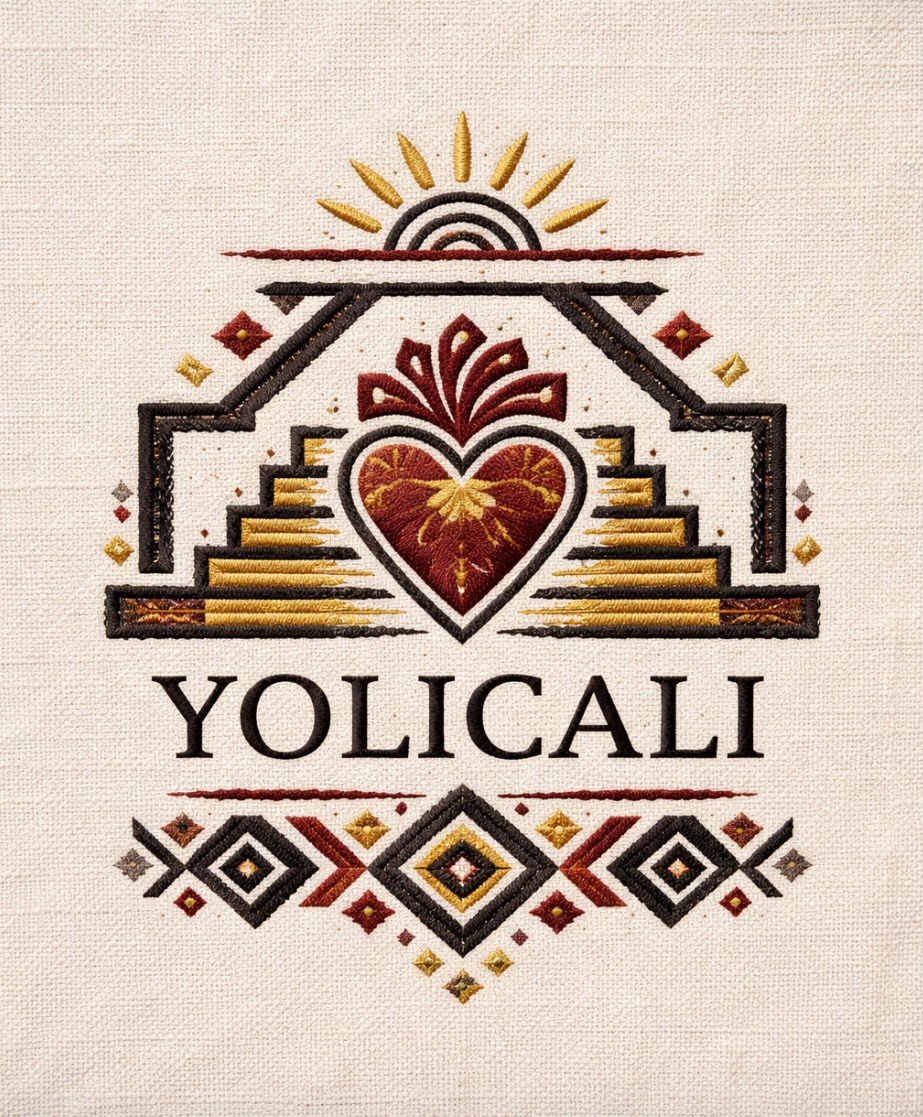
Yolicali is a name I built from Nahuatl components. Yoli (or yollotl) means life, heart. -cali means house, home. It isn’t a dictionary word, but the roots are authentic. Names don’t have to be in the dictionary. This one has meaning to me and fits the spirit of the language. A home that holds life and heart.
The logo carries the same idea: a sacred heart at the center of a stepped temple, flanked by the angular forms of a house rendered in the geometric vocabulary of Mesoamerican design. A half-sun radiates above. Diamond and arrow motifs frame the base. It reads as both pre-Columbian and deeply personal — a heart inside a home, which is exactly what the name means.
The typeface
Body text and headings are set in Equity, designed by Matthew Butterick. Equity is a serif in the Ehrhardt tradition, built for long-form reading. The section headings use Equity’s small caps — real small caps, drawn at the correct optical weight, not scaled-down capitals. Equity is a commercial typeface, and I paid for it gladly. The “free” fonts from services like Google Fonts are free because, again, you are the product — every page view phones home, and your visitors get tracked whether they know it or not. Paying a type designer for good work and hosting the files yourself is better for everyone. Every byte comes from Pepe, my little server.
The hedera
The section divider is a hedera, also called an aldus leaf (❧). It is one of the oldest typographic ornaments, dating back to early printed books in the 15th century. Printers used it to mark paragraph breaks and section divisions. The name comes from Aldus Manutius, the Venetian printer who helped establish many of the conventions of the printed book. The hedera also serves as the site’s favicon.
The images
Images here are real, mine, taken from iPhone. No stock photography. Hosted stock image services do the same thing the font services do — they track your visitors and homogenize the web until every site looks like the same airport lounge. Take a picture. Make something. It’s better. (By the way, the tracking and needed JavaScript are why I also don’t have a contact form, preferring a simple old-school mailto: link that opens your mail app.)
Images are served in JPEG XL, a modern format offering superior compression at equal or better quality than JPEG. Browsers that don’t yet support it receive a standard JPEG fallback via the HTML <picture> element. No visitor is left behind; no bandwidth is wasted.
The plumbing
Most of the internet runs on bloated, ad-laden website builders that produce slow, generic pages answering to someone else’s idea of what your site should be. I lay all of this out because it took me a long time to find each of these pieces, and if it saves someone else the hunt, good. If you care about this sort of thing — or if you want something of your own that is fast, clean, and yours — I might know someone who can help.
Pepe, my site’s dedicated, efficient little server, lives at Datacenter Light in Germany, which operates with 99.9% hydropower from the Alps and 0.1% solar power. It does not share an address with any other site. It runs Rocky Linux for the operating system, nginx for the web server, and is encrypted by Let’s Encrypt.
The domain is registered through DonDominio, a Spanish registrar based in Mallorca. DNS is at deSEC, a non-profit in Berlin that provides free, open-source DNS hosting with automatic DNSSEC signing. Every query is authenticated. No logging of queries or IP addresses.
Email is handled by Proton Mail, based in Geneva. End-to-end encrypted, zero-access — not even Proton can read the mail. Swiss privacy law, no venture capital investors, and a non-profit structure that puts people before profits permanently.
I’m increasingly aligned with the digital sovereignty movement — the idea that some or all of your data, your infrastructure, and your communications should not be subject to the jurisdiction or surveillance of a government you don’t trust. Everything that runs this site reflects that.
The payment
Payment is handled by Stripe. No payment information ever touches this server. Stripe is used by millions of businesses worldwide and meets the highest standards of payment security. I chose it because it is clean, reliable, and stays out of your way — the same reasons I chose everything else here.
The covenant
No tracking pixels. No analytics. No stupid elements that chase you down the page as you scroll. No affiliate link nonsense. No sponsors. No cookies. No pop-ups. No algorithm deciding what you see. No data sold. Ever.
If I recommend something, it’s because I think it’s worth your time.
This is the internet I still believe in. (*)